 Rohan Pariyar - Dress Designer
Seated with her right hand resting above her left, the Mona Lisa symbolizes Renaissance art’s
portrayal of a virtuous woman and a devoted wife. Widely theorized as the wife of an affluent
silk merchant, she is dressed in 16th-century Florentine fashion.
She is not wearing any jewellery, and her hair is elegantly simple, gathered atop her head, allowing
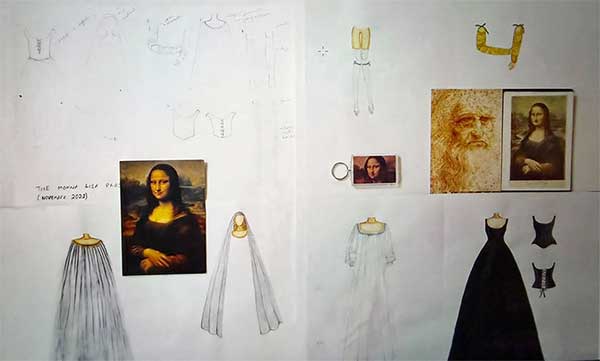
the curls that frame her face to flow freely. The first of the many items of clothing is stockings, which
were made from bias-cut fabrics of wool, velvet, silk, or linen. She could possibly be wearing hand
knitted silk stockings given her status in the society. Just below her knee, she secures a pair of garters,
traditionally fastened on the outside of the knee to avoid constraining her movement.
Next, she wears a chemise or camicia, a linen undergarment worn along the skin. It is long and
voluminous, with sleeves extending wide beyond her wrists.
The next item would be a gamurra or camurra, worn over the chemise. It was a popular dress style
of the 15th and early 16th centuries. Its bodice is stiffened like a corset with bones, typically crafted
from whalebone or metal. This helped to embrace the shape of her body, accentuating her curves. It
could be laced up either at the front or back using metal rings or meticulously hand worked eyelets.
Florentine fashion favoured a wide, slightly off-the-shoulder neckline, as in the case of the Mona Lisa,
with a hint of her bust. Her skirt is richly gathered at the waist.
The gamurra, while considered informal attire, was worn at homes, though the fabrics used could still
be very expensive.
Sleeves were separate from the bodice. They were tied in place at the shoulders, with puffs of the
chemise intended to be seen. While sleeves could be elaborate, embroidered, and bejewelled, the
Mona Lisa’s sleeves remain soft and simple. Her sleeves contrast her garment as we see golden sleeves
paired with the black gammura. The slightly extended length of the sleeves is considered a subtle
display of wealth.
Unlike in a formal setting where a lady might wear one or two additional garments over the gamurra
and accessorize with fine jewellery, the Mona Lisa wears a guarnello, an informal over gown.
A guarnello was typically associated with children, pregnancy, or perhaps breast feeding. They were
usually made of linen, but Mona Lisa’s is made of silk with gold silk embroidery that controls the
gathers at the neckline. Although the guarnello would be worn loose during pregnancy, it is widely
believed that the Mona Lisa’s is tied at the waist with a sash.
A gold-wired coif was placed at the back of her head to cover the hair, providing a means to fasten fine
linen, or as in this case, a silk veil, in place. Thus, this ensemble completes the informal day-at-home
outfit of a Florentine lady who sat down to be painted by the greatest painter of all times.