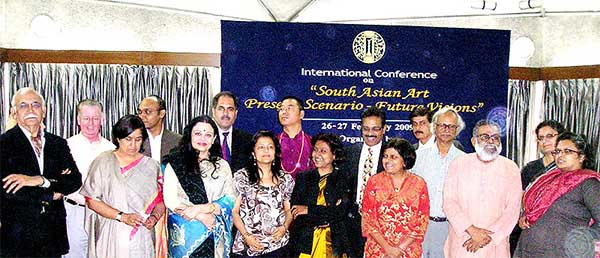
The SAARC countries have emerged as vital contributors to the development of a modernist worldview, reflecting the changing face of the region and its complex relationship with tradition. Across South Asia, inherited forms, ideas and identities are constantly being reinterpreted within contemporary social, political and cultural contexts.
Art has always reflected this dynamic dialectic in a distinctive and powerful manner. Yet, it has not often been examined as a canvas through which the concerns, aspirations and values of the nations of South Asia can be understood. The region's artistic practices reveal both points of convergence and divergence—between the traditional and the contemporary, the local and the global, and shared histories and distinct national identities.
Against this backdrop, Habiart Foundation, in association with the India Council for Cultural Relations, initiated an important dialogue through this seminar. The objective was to explore how modern artistic interpretations across South Asia engaged with, reinterpreted or challenged traditional content and styles, and how the individual cultural identities of the region had evolved in response to changing social, political and cultural equations.